By Propzine – Bengaluru’s Trusted PropTech Platform
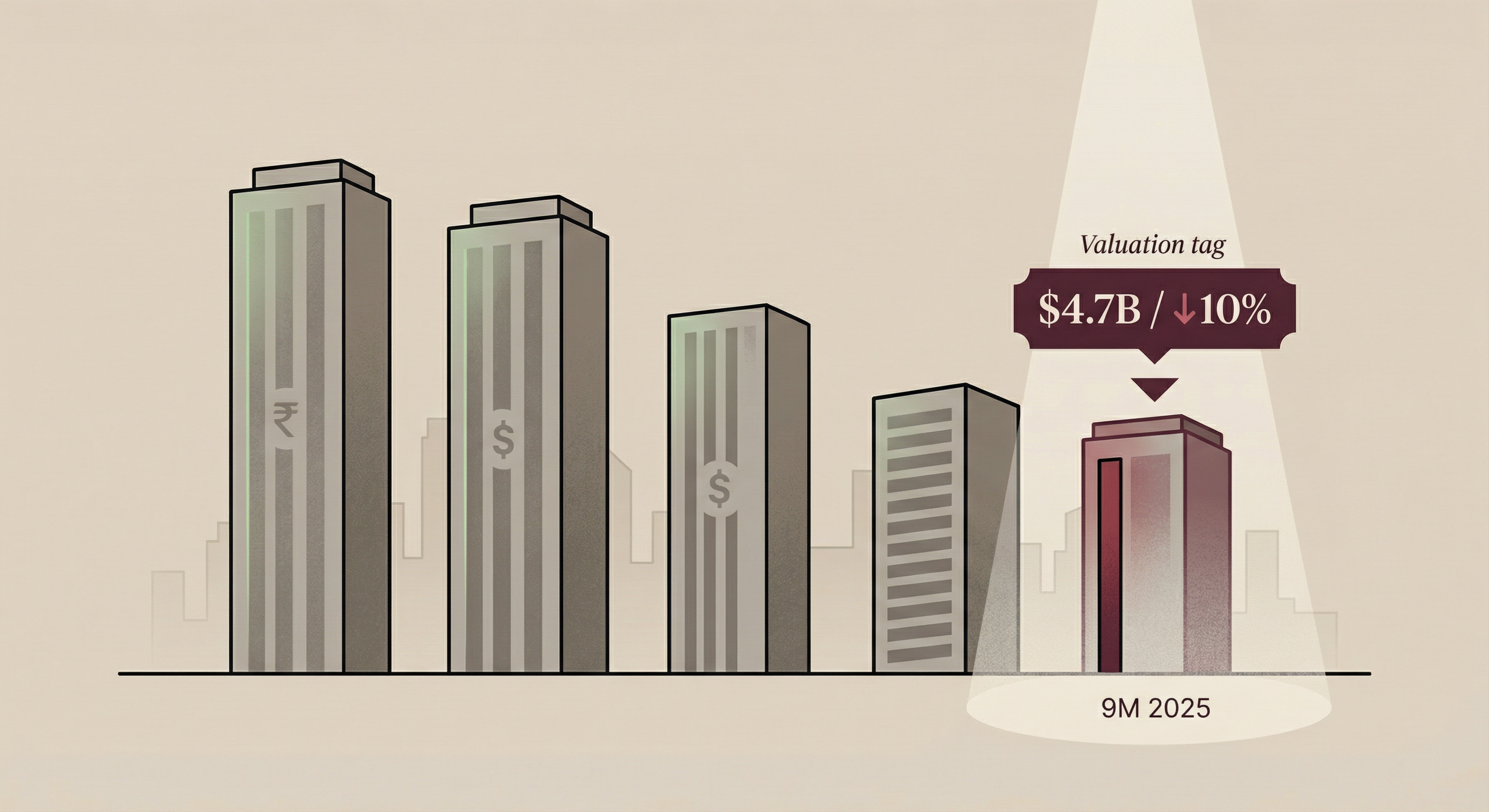
India’s real estate investment landscape is undergoing a pivotal shift in 2025. According to data released on November 10, institutional investment in real estate India fell by 10% to $4.7 billion during the January–September period of 2025, compared to $5.2 billion recorded during the same period last year. While this signals a cautious stance among global investors navigating macroeconomic uncertainty, the underlying story reveals something more important—commercial real estate continues to anchor India’s investment cycle, commanding a massive 62% share of total deals.
Even with funding pressures and volatile global capital flows, India remains a preferred market for FDI in real estate 2025, driven by the durability of Grade-A office assets, the expansion of GCCs, and logistics sector transformation. For a proptech ecosystem like Bengaluru’s, this shift is opening new pathways for data-led investment strategies.
Institutional Capital Moderates as Global Headwinds Weigh on Allocation Decisions
The 10% drop in institutional inflows is tied closely to global macroeconomic headwinds—tightened liquidity, elevated interest rates, geopolitical friction, and recalibrated investment mandates across major sovereign funds and pension pools. Many global investors have shifted toward capital preservation, delaying large-ticket acquisitions and adopting portfolio defensiveness.
Yet, India’s real estate continues to outperform peers in Asia-Pacific, attracting long-term capital due to:
• Steady economic growth despite global volatility
• Deepening transparency in the property sector
• Improved regulatory frameworks
• Growing availability of institutional-grade assets
Commercial Property Investment Trends: Grade-A Offices and Logistics Lead the Pack
Despite the overall decline in funding, commercial property investment trends remained robust, securing 62% of all institutional deals in 9M 2025. This reaffirms investor preference for income-yielding, stabilised commercial assets, which provide predictable returns, inflation hedging, and long-term tenancy commitments.
Two categories stood out:
1. Grade-A Office Parks
Large U.S. and Middle East funds continued to strengthen their India office portfolios, particularly in Bengaluru, Hyderabad, and Pune. The expansion of Global Capability Centres (GCCs), return-to-office momentum, and multi-city corporate consolidation pushed commercial demand forward.
2. Logistics & Industrial Warehousing
Institutional investors increased allocations to industrial assets, targeting:
• Last-mile delivery warehouses
• Tier-1 periphery logistics clusters
• Grade-A multi-modal industrial parks
The sector’s high leasing velocity and stable yield profile offer a safer bet compared to residential development cycles.
Residential Bets Lose Momentum as PE Investors Prioritise Stability
Private equity (PE) investment in the residential property sector softened substantially. High construction costs, longer gestation periods, and market consolidation have reduced investor appetite for early-stage residential projects.
Instead, investors prefer:
• Income-yielding assets
• Stabilized commercial platforms
• Operational retail centers
• Industrial & warehousing estates
This strategic pivot reflects a broader global trend capital is moving toward sectors that deliver steady cash flows over speculative development upside.
Why India Remains a Long-Term Investment Magnet Despite a Temporary Dip
Even with a 10% drop, India registered one of the highest institutional inflows in Asia-Pacific. A few reasons stand out:
• Strong leasing momentum in the commercial office sector
• High-quality asset creation by major developers
• Improving transparency and compliance norms
• Rapid formalisation of logistics and warehousing
• Growing REIT ecosystem offering liquidity and governance
India’s real estate sector is now viewed as low-risk, high-stability, making it attractive for global investors seeking portfolio diversification.
Bengaluru: The Nucleus of Institutional Real Estate Investment in India
As India’s technology and innovation capital, Bengaluru remains the top destination for commercial real estate capital deployment. Factors contributing to its dominance include:
• Largest GCC footprint in India
• Deep talent pool attracting multinational expansion
• Strong absorption in ORR, Whitefield, Bengaluru North
• Growing demand for logistics hubs around Hoskote, Nelamangala, and Devanahalli
• Rapid adoption of proptech solutions for leasing, asset management, and due diligence
For a Bengaluru-based proptech platform like Propzine, this shift toward stable, data-driven commercial investments unlocks new opportunities for market intelligence, asset discovery, and investor matchmaking.
Conclusion: Commercial Real Estate Holds the Fort as India Navigates Investment Realignment
The 10% correction to $4.7 billion in 9M 2025 is not a sign of structural weakness—it reflects global capital turbulence. However, the 62% dominance of commercial deals underlines the strong fundamentals of India’s income-yielding property segments. Institutional investors may be cautious today, but their long-term conviction in Grade-A offices and logistics assets remains unshaken.
As global conditions stabilize, India is expected to re-accelerate into its next investment upcycle. For developers, asset owners, and proptech innovators, the message is clear: commercial real estate will continue to be the anchor of institutional capital flows in 2026 and beyond.